
Paper Bag Size Guide:
How to Specify Height, Length and Width
A paper bag is specified H × L × W — height, length, width. Most re-orders that come back wrong were quoted on height and length alone.
That sentence sounds like a formatting preference and is actually the most expensive mistake in the category. A bag quoted on two numbers is a bag with no volume: the face will be right, the bag will be flat, and the product will not sit in it the way the drawing promised. The width is the gusset, and it is not a detail added to a size — it is one of the three numbers that define the size.
Three numbers, one order THE BANDS
Four published size bands THE SHEET
Eight lines for your enquiry
Why H × L × W, and Not H × L
A paper bag has three dimensions, but only two of them are obvious. Height is base to top edge — what you see when the bag stands. Length is the flat face — what you see when it is photographed. Width is the gusset: the folded side and bottom panel that turns two flat sheets into a container, invisible in every front-on image, which is precisely why it gets left out of briefs.
The confusion gets worse because the same two words are used loosely in the trade. A bag quoted 25 cm long may mean a 25 cm face, or 25 cm across including both side gussets — and those are not the same bag. When the terms are not explicit, the quote is a guess with a decimal point. Write the face and the gusset as separate numbers: length first, width second.
The chain that works runs in one direction: product outside dimensions, then the fit allowance you want, then the finished bag H × L × W. Running it backwards — picking a nice-looking bag and hoping the product fits — is how a re-order ends up as a re-tool. The fit allowance itself is not a fixed margin; it depends on how rigid the product is, whether there is an insert, and how much room the counter staff need at pack-out. That is a sample decision, and it is worth one round of samples rather than one round of guesses.
The published version of all of this — four size bands, four board grades, gusset quoted with the bag — sits on custom paper bags.
Two numbers describe a face. Three numbers describe a bag. The third one is the width — the gusset.
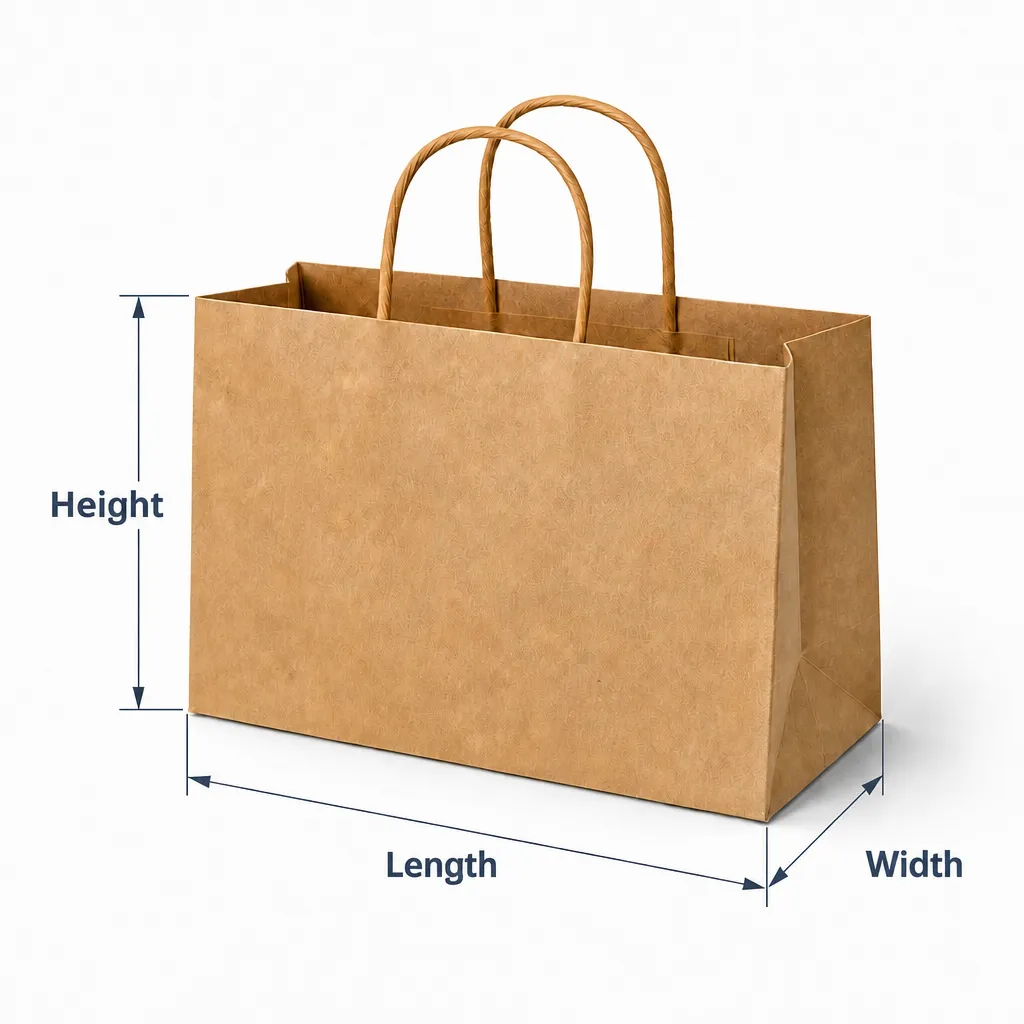
Landscape
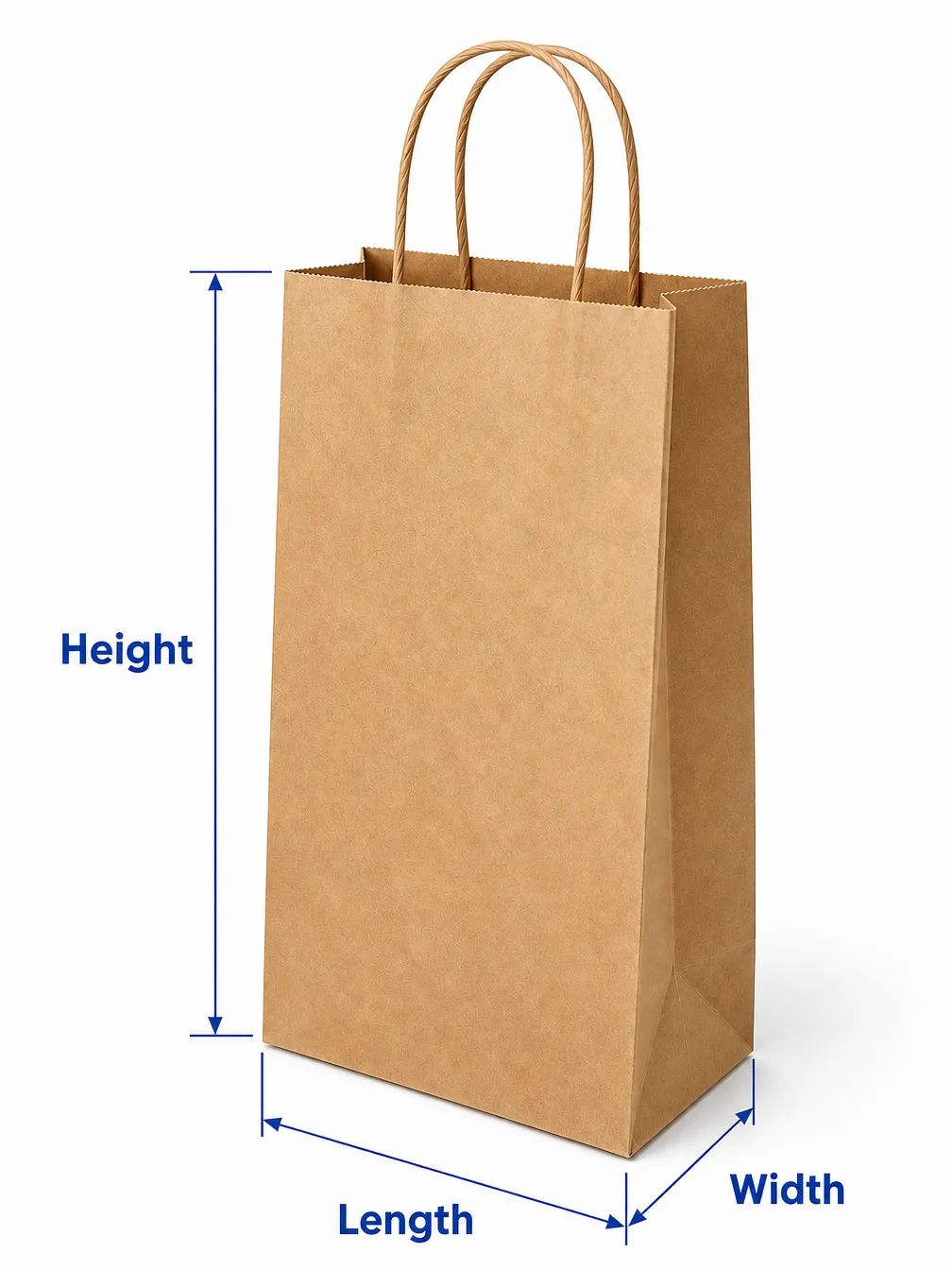
Portrait
The Four Published Size Bands
Sizes are published as four bands rather than a catalogue of fixed bags. The band sets the tooling, the practical board range and the freight profile; the exact dimensions inside it are built to your drawing.
| Band | Typical use | What changes |
|---|---|---|
| Under 20 cm | Jewellery, fragrance, small accessories | Handle detail dominates the panel; the bag is read at arm's length |
| 20–30 cm | Boutique retail, beauty sets, gifting | The retail default — enough panel for a logo and a handle without crowding |
| 30–45 cm | Apparel, multi-item purchases | Panel flex becomes visible; the grade has to hold the face |
| Over 45 cm | Outerwear, homeware, large sets | Top-edge length spreads the load — and the handle choice matters more |
Bands per published structure specs · exact height, length and width built to drawing within the band
A bag can also sit on a band boundary, which is worth flagging in the enquiry rather than leaving to the quote. If your drawing is close to a boundary, say which side you expect it to fall on and why — the tooling decision follows the band, and moving a bag across a boundary after the die is cut is a re-tool rather than a resize.
How Board Grade Follows Size
The published grades are 230, 250, 280 and 300 gsm. The relationship between grade and size is not a rule, but it has a direction: as the panel grows, the same grade flexes more, so a large bag usually moves up a grade rather than down. A wide face in a light board is where a paper bag reads as flimsy before anyone has picked it up.
The other half of the decision is what the bag carries. A bag with a single light item and a bag with several dense ones can share a footprint and still need different grades, because the panel is doing different work. That is why the grade is confirmed against the loaded bag rather than against the size band alone — and why this page does not publish a size-to-grade table. A table would look authoritative and be wrong at the edges, which is exactly where buyers need it to be right.
There is one more interaction worth knowing: the handle. A die-cut handle puts the load into the board, so grade and cut geometry carry it together; an anchored handle puts the load into the turn-over, which is a build decision at the top edge rather than a grade decision. The four forms and what each one asks of the bag are compared in paper bag handle types.
How Gusset Depth Is Actually Decided
The gusset — the width in an H × L × W specification — is usually described as a side fold, but it does two jobs. The side gussets set how far the bag opens and how it stands; the bottom gusset carries the base and takes the load first when the bag is lifted. They are usually quoted together as one dimension, and on most retail bags they are built to the same depth.
Depth follows the product's stack, not the product's width. Two products with the same front face can need very different gussets: a flat garment needs almost none, while a boxed set needs enough depth for the box plus the room to slide it in. The reliable brief states the product's outside dimensions including depth, and the fit you want around it — the gusset is then set from that, not from a standard number.
There is a cost consequence worth stating plainly. Gusset depth consumes material and changes the die-line, so it is quoted with the bag rather than added afterwards. Increasing depth after sampling means a new die, not a wider fold. That is why the depth belongs in the first brief, alongside the width and the height, rather than in the second round of feedback.
The Eight-Line Specification Sheet
This is the shortest brief that can be quoted without a follow-up call. Copy it into an email, fill in the right-hand column, and the reply is a quote rather than a questionnaire.
| Line | What to write |
|---|---|
| Finished size | H × L × W in cm — height, length, width (gusset depth) |
| Board grade | 230 / 250 / 280 / 300 gsm, or the nearest published grade to your brief |
| Paper | art paper, kraft, cardstock, specialty textured, coated board or white card |
| Handle | ribbon, applied bow, die-cut or webbing |
| Gusset | side and bottom, depth quoted with the bag |
| number of sides, colour count, and whether coverage is full-surface | |
| Surface | matte or soft-touch lamination, spot UV, foil stamping, blind debossing — or none |
| Quantity and terms | units, destination market, DDP |
Fields map to published structure specs · quantity and terms quoted DDP to your destination
If the print side is what you are still unsure about — colour count, coverage, whether the panel is printed in one pass — that belongs to the same brief and changes with the quantity you write on line eight. The published print thresholds and how quantity decides the process are set out on the custom printed paper bags specification page.
Paper Bag Sizes, Answered
How do I measure a paper bag? +
Measure the finished bag flat: height from the base fold to the top edge, length across the flat face, and width at the side gusset. Those three numbers, in that order, are the specification. Measuring a bag lying open or measuring the product instead of the bag is where most quoting errors start.
What is a gusset on a paper bag? +
The folded side and bottom panels that let a flat bag open into a volume. In a specification it is the width — the third number in H × L × W — and it is quoted separately from the face because two bags can share a length and hold very different amounts.
What paper weight should a paper bag use? +
The published grades are 230, 250, 280 and 300 gsm. The grade follows the panel size and what the bag has to carry: a larger panel flexes more at the same weight, so it usually moves up a grade rather than down. The final choice is confirmed on the working sample, not from a table.
What sizes do paper bags come in? +
Four published bands: under 20 cm, 20–30 cm, 30–45 cm and over 45 cm. The band sets the tooling and the practical grade range; the exact height, length and width inside that band are built to your drawing.
How much bigger should the bag be than the product? +
There is no single allowance, because it depends on how rigid the product is, whether there is an insert, and how easily it has to go in and out at the counter. The reliable method is to specify the product's outside dimensions and the fit you want, then check the allowance on a working sample rather than adding a fixed margin to a drawing.
Two ways forward
The Lab Report
BrandPackagingLab — Lab Engineering Desk. Engineering notes on premium packaging, tested against real buyer behaviour.
Size bands and board grades per published structure specs · fit allowance and gusset depth confirmed on the working sample