
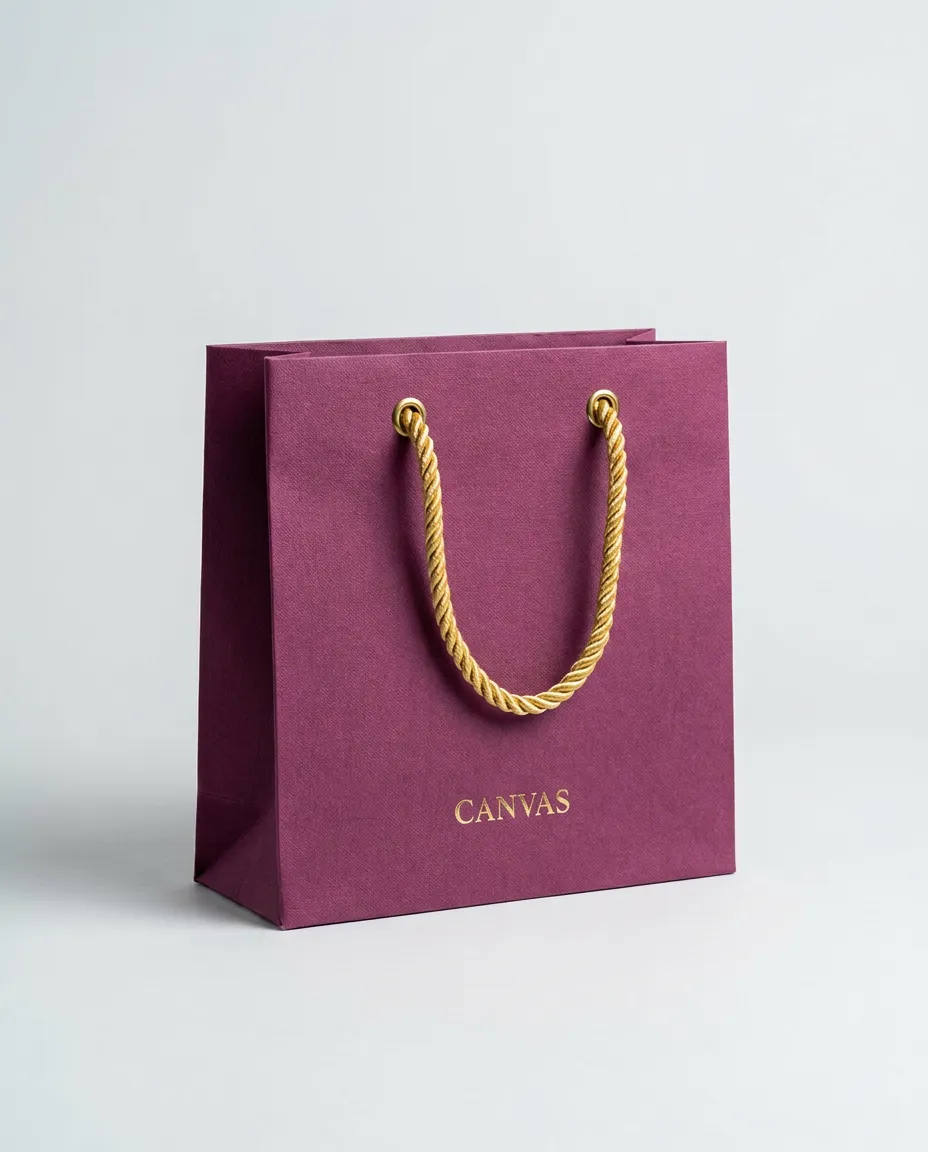
Three Ways a Paper Bag Fails
These are the failures buyers report. None is a print problem.
The handle pulls out.
A handle is only as strong as what it is anchored into. Ribbon and webbing are set into a reinforced turn-over; a die-cut handle is the board itself. When the top edge is not built for the load, the handle fails at the anchor — not at the handle.
The gusset splits.
Side and bottom gussets are where a loaded bag takes its stress. An under-built gusset opens along the fold line the first time the bag is picked up full. Depth is a specification decision, quoted with the bag. How to specify height, length and width.
The print drifts.
Registration drift is most visible on the large flat panel of a bag, where there is no fold to hide it behind. Full-surface print also means the second run has to match the first — a paper lot question, not a design one. The print method decides how much of that risk you carry.
Choosing the Handle: The First Decision
The handle is the part your customer touches first and the part that fails first. Six forms cover nearly all retail work, and they differ in how they are anchored and fixed — not in how they look.
Ribbon and webbing depend on the top edge, so the turn-over matters more than the ribbon grade. A die-cut handle moves the load into the board, and the board grade carries the decision. An applied bow is assembled by hand, which makes the run a craft run.
| Dimension | Ribbon handle | Applied bow handle | Die-cut handle | Webbing handle |
|---|---|---|---|---|
| How it is made | Ribbon set into a reinforced turn-over | Ribbon bow applied by hand to the top edge | Cut from the board itself — no rope or ribbon | Woven webbing stitched into the top edge |
| Load character | Carries the load in the ribbon, spread across the top edge | Decorative first; the bow is hand-set, so the run is a craft run | Load sits in the board; the top edge has to be graded for it | Flattest and strongest against the hand over time |
| Best fit | Fashion, jewellery, premium retail | Gifting, occasion, PR | Everyday retail where a clean, rope-free look is the point | Apparel, beauty, high-traffic boutique |
| Cost driver | Ribbon grade and hand-set assembly | Hand application time | Die plus board grade | Webbing grade and stitching |
| Sold as | custom-ribbon-handle-paper-bags | custom-bow-handle-paper-bags | custom-die-cut-handle-paper-bags | custom-apparel-paper-bags |
Anchor types and cost drivers per published structure specs · load confirmed on the working sample, never quoted as a figure
Two further forms run on the line — twisted paper and cotton rope — and every handle is fixed one of three ways: punched and threaded, glued inside the top edge, or riveted. The fixing is where most field failures start, and it is specified separately from the material.
The same decision appears under a different name when the shape changes. A gable box with handle is a box with a carry feature rather than a bag, but the buying question is identical: what carries the load, and what is it anchored into. All six forms are compared in detail in paper bag handle types.
Paper, Weight, Size and Gusset: The Published Spec
These are the numbers we publish. If a supplier will not put them in writing before you order, you are buying a sample, not a specification.
| Dimension | Published values |
|---|---|
| Paper options | art paper 210–250 gsm · kraft 200–250 gsm · cardstock · specialty textured paper · coated board · white card |
| Board grades | 230 / 250 / 280 / 300 gsm |
| Size bands | Under 20 cm · 20–30 cm · 30–45 cm · Over 45 cm |
| Gusset | Side and bottom gusset, depth quoted with the bag |
| Handle forms | Ribbon · applied bow · die-cut · webbing |
| Surface | offset print · CMYK offset · flexo print · matte lamination · soft-touch lamination · spot UV · foil stamping · blind debossing · applied ribbon bow · die-cut handle |
Paper options and board grades are published as two separate fields; the grade a specific bag runs at is fixed on the working sample
Two of those rows do most of the work in a quote. Board grade against the load decides whether the bag holds its shape when full; gusset depth decides how much it can hold at all. A bag specified on height and length alone arrives too shallow.
Surface treatment has its own economics: packaging finishes covers lamination, spot UV and foil as processes rather than options in a list.
| Dimension | Paper bag | Magnetic rigid box | Lid & base box | Folding carton |
|---|---|---|---|---|
| Primary use | Carrying the purchase out of the store | Presenting the product | Formal presentation | Retail shelf |
| Structural core | Paper board + gusset + handle anchor | Greyboard core + hidden magnets | Greyboard lid over base | Folding board |
| Cost driver #1 | Handle form and print method | Magnet count and hand assembly | Wrapping and hand assembly | Die and print run |
| Freight volume | Low (ships flat) | High when fixed | High | Low (ships flat) |
| Reuse by the buyer | High — carries the brand after the sale | Moderate | Moderate | None by design |
Structural cores and cost drivers per published structure specs · no price figures on this page
Two of those columns have their own engineering pages: the presentation structure is custom magnetic rigid boxes, where the decision is board thickness and magnet placement, and the formal alternative is lid and base rigid boxes, where the feel lives in the lid-to-base fit.
Where Paper Bags Earn Their Keep
The bag is the only piece of packaging that leaves the store with the customer and keeps advertising after the sale — which is why the handle and panel carry more weight here than on a box opened once.
Retail & Boutique
Carried out of the store, seen on the street — the bag keeps working after the sale
IndustryApparel & Beauty
Soft goods and bottles, where the handle is under load and the panel is the billboard
IndustryGifting & Occasion
The bag is part of the gift rather than transport for it
IndustryKraft & Eco Retail
Uncoated stock, simple fibre stream, no claim that outruns the material
Six published structures cover the retail work this line does. Each has its own spec sheet — board, MOQ band, lead time and DDP destinations — so nothing here has to be taken on trust:
Custom Ribbon Handle Paper Bags
Ribbon set into a reinforced turn-over — the retail default
Spec sheetCustom Printed Paper Bags
Full-surface print, colour count drives the plate set
Spec sheetCustom Apparel & Beauty Paper Bags
Webbing handle, built for weight and repeat handling
Spec sheetCustom Bow-Handle Paper Bags
Applied bow, hand-set — a craft run rather than a fast run
Spec sheetCustom Die-Cut Handle Paper Bags
The handle is the board — nothing to pull out
Spec sheetCustom Kraft Paper Bags
Uncoated kraft, one ink or none, at the lowest tooling cost
If you are still comparing shapes rather than specifying one, the paper bag catalog puts the same six structures side by side with their photographs.
From 50 Units, on an Offset Press
Quantity decides which printing path is open to you, long before the design does.
Most suppliers quote offset from 1,000.
Sheet-fed offset carries plate and make-ready cost, so small orders get pushed to digital or turned away. On our line the offset press is available from 50 units.
What that means at our minimum.
Our custom minimum is 50 units — the same number as the offset threshold, so a first order at the minimum already runs on the press.
Why the threshold can be 50.
The make-ready happens on our own line rather than inside a middle layer's margin — a difference in cost path, not a discount, and why the number can be put in writing.
Where digital still wins.
For proofs and pre-production trials. Digital carries no plate cost, which is how a working sample gets made — but it is not the route for a production order below the minimum.
We will tell you when not to.
At small quantities the make-ready is spread across that run rather than a large one; if digital is the better fit at that quantity, we will say so. The same logic runs through custom paper bags under 500 units.
Offset threshold 50 units · custom minimum 50 units · no price, discount or comparison figure appears on this page
Recyclability, FSC and What Actually Gets in the Way
Paper bags carry more sustainability language than any other structure on this site, and most of it is written loosely. FSC, recyclable, biodegradable and compostable are four different claims.
Base paper is not the problem.
Uncoated paper board recycles in the standard paper stream. Where a claim usually breaks is on what was added — full-surface lamination, heavy coating, and the handle material.
FSC is about where the fibre came from.
FSC certification is a sourcing claim. It does not say a finished bag is recyclable or compostable. Our own plant holds the certificate (no. ests-coc-260312), so FSC-certified paper can be specified on this range. They are not the same claim, and combining them invites a compliance problem.
Kraft and coated are different end-of-life stories.
Uncoated kraft keeps the fibre stream simple. Coated and laminated stock looks richer and complicates it. The honest answer is that the choice is a trade-off, not a win.
If your market is the EU.
The EU Packaging and Packaging Waste Regulation applies from 12 August 2026, and it puts material and coating choices into the same conversation as the artwork. If you sell into the EU, treat the material decision as a compliance decision.
Recyclability and compostability are not claimed for a specific bag here: both depend on the material stack you order, so they belong in the specification. Are paper bags recyclable? takes them apart.
Specification Shortcut
Five inputs, one first pass. The tool narrows the lane and ends with what an engineer still has to check against your drawing.
First-pass output
- Suggested handle
- —
- Suggested board grade
- —
- Print path at this quantity
- —
- Gusset note
- —
Requires engineer review
Tool output is a first pass. Every dimension is re-checked against your drawing by an engineer before quoting.
What Backs the Claim
Own plant, on the paper bag line. Handle assembly, sheet mounting and the digital-to-offset switch all happen inside our own factory, not at a third party — which is what makes the 50-unit threshold a number we can publish.
Working sample first. The bag is made in the same board and the same handle as production; the sample cost is credited back toward the production order. The sample is where the anchor, gusset depth and registration are judged.
Published numbers only. Board grades, size bands, the MOQ floor and lead times come from the published structure specs, and this page does not extend them. Where a figure does not exist yet — a load rating, a certification scope — the page says so. The structures and photographs are collected on the product shelf.
Custom Paper Bags, Answered
What is a custom paper bag made of? +
A paper board body with a side and bottom gusset, a reinforced turn-over at the top edge, and a handle set into it. Board options run from art paper and kraft to cardstock and specialty textured paper. The turn-over is the part that decides whether the handle holds, because it is what the handle is anchored into.
What is the MOQ for custom paper bags? +
From 50 units — and 50 is also where the offset press starts, so the minimum order is already a press order rather than a digital stand-in. Below 50 we run digital for proofs and trial runs only.
Which handle should I choose? +
Ribbon, webbing or cotton rope for a softer hand-feel, die-cut when you want a flat, rope-free look, twisted paper on kraft, and an applied bow when the bag is part of the gift. The handle is the part the customer touches first, so choose on the retail context rather than on the render.
How much weight can a paper bag carry? +
Load is a function of the paper grade, the gusset, and how the handle is anchored — not of the handle alone. We confirm the load on the working sample rather than quoting a figure up front. A number measured on a bare handle tells you nothing about the bag it is set into.
What sizes do paper bags come in? +
Four bands, from under 20 cm to over 45 cm, with gusset depth specified separately for each. Size is quoted as height, length and width — not height and length alone, because the width is the gusset, and it sets the volume and the footprint on the shelf.
Are paper bags recyclable? +
The base paper is; the claim usually breaks on lamination, coating, or the handle. FSC tells you where the fibre came from — it is not a recyclability claim, and the two are frequently written as one sentence in this industry. Ask for the material specification before you write either claim into your own marketing.
How long does it take? +
Sample 3–5 days; production 15 days after artwork approval; DDP transit 9–45 days to the US, EU and UK, and 11–50 days to Australia. The quote states the per-destination lead time before you order rather than after.
Keep Reading
Paper bag handle types, compared THE CLAIM
Are paper bags recyclable? THE MEASURE
Paper bag size guide: height, length and width THE STOCK
Paper bag material: GSM, kraft and specialty paper THE RUN
Low MOQ custom packaging THE TERMS
DDP vs FOB vs EXW for packaging orders
The delivery
Start Engineering Your Project
A plain kraft bag and a luxury retail bag start from the same spec sheet. Send the dimensions, the quantity and the destination market — an engineer replies with the structure, the board grade and a DDP-inclusive quote with duties included.
Start Engineering Your ProjectDDP-inclusive quote · Working sample first · Response within one business day